
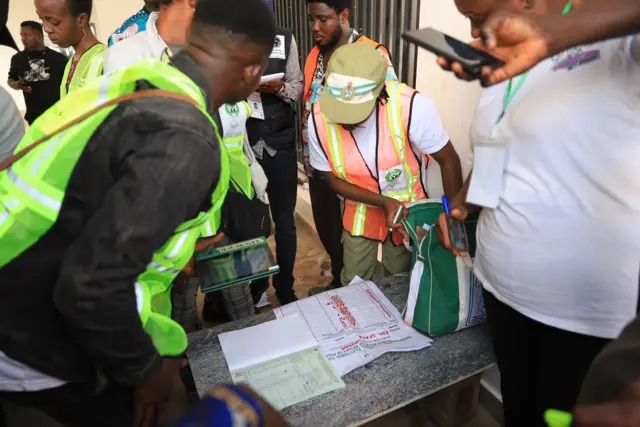
Yiaga Africa, an accredited observer group, has declared that the Edo State governorship election held on Saturday failed to meet the integrity standards due to widespread result manipulation.
In a post-election statement co-signed by Dr. Aisha Abdullahi, Chair of the 2024 Edo Election Mission, and Samson Itodo, Executive Director of Yiaga Africa, the organization highlighted several lapses in the electoral process.
The Independent National Electoral Commission (INEC) had declared Senator Monday Okpebholo of the All Progressives Congress (APC) as the winner of the election, with 291,667 votes, defeating Asue Ighodalo of the Peoples Democratic Party (PDP), who polled 247,274 votes, and Olumide Akpata of the Labour Party (LP), who garnered 22,763 votes.
Despite the official results, Yiaga Africa stated that their Process and Results Verification for Transparency (PRVT) methodology, which was deployed across all 18 local government areas with 300 stationary and 25 roving observers, revealed significant discrepancies during the collation of results.
“While there was some level of compliance in material deployment and other processes, the incidents of result manipulation and disruptions during ward and local government collation in Ikpoba/Okha, Etsako West, Egor, and Oredo LGAs severely undermine the credibility of the election results,” the group said.
Yiaga Africa’s PRVT, which has been used in two presidential elections and 16 off-cycle governorship polls, allows the group to independently assess election processes and verify the accuracy of the official results.
However, the organization stated that the official results in certain areas did not align with their independent estimates.
“Inconsistencies in the official results announced by INEC for APC in Oredo and Egor LGAs, as well as for PDP in Esan West LGA, and for LP in Oredo LGA, fall outside our PRVT estimates, indicating that the results were altered during collation,” Yiaga Africa reported.
The group condemned the actions of biased INEC officials and security personnel who, according to their findings, interfered with the collation process, enabling manipulation.
“The disparities between the official results and Yiaga Africa’s PRVT estimates point to manipulation during the collation process,” the statement noted.
Yiaga Africa also criticized the violence and disruption during the voting and collation processes, especially in areas like Ikpoba/Okha and Etsako West, where political thugs attacked voters and election officials.
“Such actions undermine the integrity of the election and call into question the credibility of the entire process,” they added.
Despite a high rate of PVC collection, Yiaga Africa reported a voter turnout of only 22.4%, lower than the 27% turnout observed in the 2020 election, further signaling a lack of voter engagement.
Nevertheless, the group commended the determination of voters who braved bad weather and delays to exercise their civic rights, saying, “Yiaga Africa applauds the resilience of voters who turned out despite the rain and delays.”
In response, an unnamed INEC official dismissed Yiaga Africa’s findings as insufficient to judge the election, stating, “There are mechanisms for aggrieved parties to explore, and Saturday’s statement by Mallam Mohammed Haruna that the commission would review complaints it received and act accordingly still stands.”
As questions surrounding the credibility of the election linger, Yiaga Africa’s statement adds to the growing scrutiny of Nigeria’s electoral process.
