
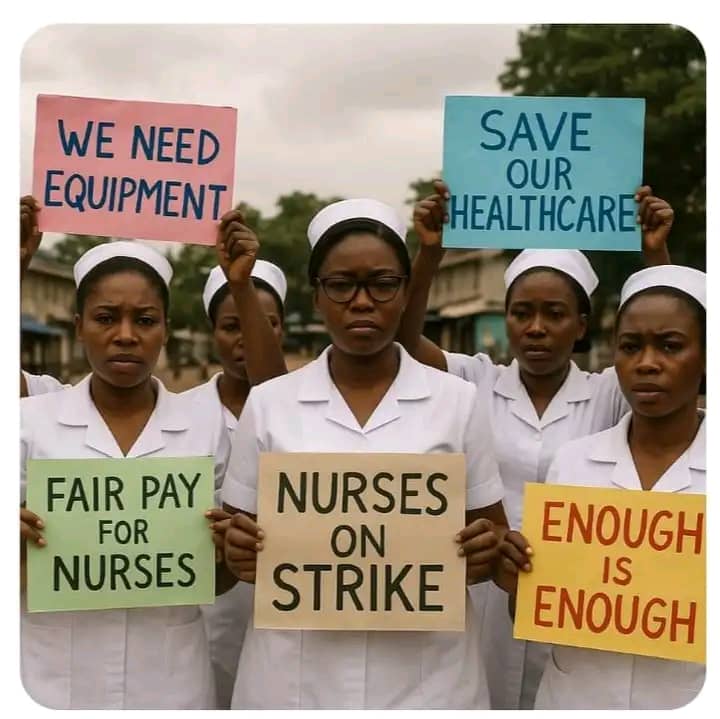
The National Association of Nigerian Nurses and Midwives (NANNM), Federal Health Institutions Sector, has insisted that its nationwide seven-day warning strike is still in full force, despite a closed-door meeting held on Thursday with the Coordinating Minister of Health and Social Welfare, Prof Muhammad Ali Pate.
The industrial action, which began on Wednesday, was triggered by what the union describes as “the persistent neglect and disregard” for the welfare of nurses working in federal health institutions across the country.
Key among the union’s demands are the upward review of shift and uniform allowances, a separate salary structure for nurses, increase in core duty allowance, mass recruitment to address workforce shortage, and the creation of a dedicated nursing department within the Federal Ministry of Health.
Reacting to reports suggesting that the strike had been called off, NANNM-FHI’s National Public Relations Officer, Omomo Tibiebi, dismissed the claims as false and misleading.
According to him, only the, union’s National Executive Council has the authority to suspend the strike.
“The strike has not been suspended,” Tibiebi stated firmly. “Yes, the NANNM executives met with the Coordinating Minister today, but it was the Minister who went to press to announce that the strike had been called off.
He wasn’t the one that declared the strike in the first place, so he has no authority to call it off.”
The union noted that the outcome of the meeting with the Health Minister would be tabled at the NEC meeting scheduled for Saturday, where a decision will be taken on whether or not to suspend the strike, depending on the Federal Government’s response to their demands.
Meanwhile, in Abeokuta, the acting Chairman of NANNM at the Federal Medical Centre, Idi-Aba, Comrade Samson Akintunde, confirmed that nurses at the institution are actively complying with the strike directive.
He said the situation was regrettable but necessary due to years of poor treatment and unfulfilled promises by successive administrations.
“Here at FMC Abeokuta, we are observing the strike fully. Nurses are exhausted, overworked, and underpaid,” Akintunde told Medalinks News 24 in an interview.
“Some of us work 24-hour shifts without proper compensation. Our allowances are outdated, and promotions are either delayed or denied. We can’t continue working under such conditions.”
Akintunde also lamented the shortage of personnel at the centre, saying it compromises patient care and places an unbearable burden on the few available hands.
“Many of our trained nurses are leaving the country in droves because they don’t see a future here. The system is pushing us away,” he added.
Hospitals across the country have already started feeling the impact of the strike, with patients at various federal medical centres reportedly left unattended or being redirected to private facilities.
Though emergency departments are said to be open, services remain skeletal.
While the Federal Government has appealed for calm and urged the nurses to return to work in the interest of the public, many stakeholders believe the agitation speaks to a deeper systemic rot in Nigeria’s health sector.
For now, all eyes are on Saturday’s NEC meeting of NANNM, where the fate of the ongoing strike – and potentially the fate of federal hospitals – will be decided.
