
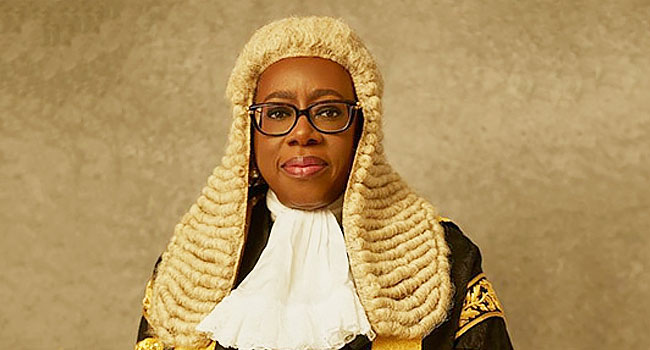
The Chief Justice of Nigeria (CJN), Justice Kudirat Kekere-Ekun, has reassured the nation’s key anti-corruption agencies of the Judiciary’s unwavering support in the battle against corruption.
Justice Kekere-Ekun made this commitment during a two-day capacity-building workshop organized by the Economic and Financial Crimes Commission (EFCC) and the National Judicial Institute (NJI) for Justices and Judges in Nigeria.
Addressing participants, Justice Kekere-Ekun emphasized the Judiciary’s vital role in ensuring justice is served in corruption cases, highlighting the need for strong collaboration between the Judiciary and agencies such as the EFCC, the Independent Corrupt Practices Commission (ICPC), and the Nigerian Financial Intelligence Unit (NFIU).
“The Judiciary plays a critical role in the fight against corruption, and this requires a strong synergy between the courts and anti-graft agencies,” she stated.
However, she called for improved efficiency in the investigations carried out by these agencies, noting that poorly conducted investigations often hinder the smooth dispensation of justice.
“Efficient investigations are key to avoiding unnecessary delays that could clog the wheel of justice in court,” she added.
The Senate President, Senator Godswill Akpabio, represented by Deputy Senate President, Senator Barau Jibrin, echoed similar sentiments, emphasizing the need for a centralized data system accessible to all anti-corruption agencies to enhance information sharing and coordination.
He also advocated for regular training for investigating officers to improve their capacity in handling complex cases.
Meanwhile, the EFCC Chairman, Olanipekun Olukoyede, raised concerns over the Commission’s inability to carry out investigations in 10 Nigerian states due to court orders restraining its activities.
Though he did not specify the affected states, Olukoyede lamented the frequent court injunctions that impede the EFCC’s efforts, along with the recurring adjournment of high-profile cases, contempt orders, and excessive reliance on technicalities by courts.
“One of the major challenges we face is the frequent issuance of court orders that prevent us from carrying out investigations in certain states.
These obstacles, coupled with delays in court proceedings, hinder the effectiveness of our operations,” Olukoyede said.
The workshop aimed at strengthening collaboration between the Judiciary and anti-corruption agencies to enhance justice delivery in corruption-related cases, also provided a platform for key stakeholders to address challenges and propose reforms to ensure that justice is both swift and fair.
