

…Health workers demand fair treatment, inclusion in policymaking
…Patients stranded as hospitals reel from critical nursing shortages

By Akinpelu Abiola
For Nigeria’s nurses and midwives, the seven-day nationwide warning strike declared by the National Association of Nigerian Nurses and Midwives (NANNM) is not merely a protest — it is a loud, painful cry from a profession stretched beyond its limits.
Years of chronic underfunding, overwhelming workloads, and exclusion from decision-making have left many healthcare workers feeling broken, ignored, and expendable in a sector that depends so heavily on their care and expertise.
At the Federal Medical Centre in Idi-Aba, Abeokuta, the acting NANNM chairperson, Adekunle Olufunmilola, paints a picture of daily exhaustion.
“We are not happy this is happening,” she says of the strike, “but we are tired of covering up for what the government has failed to provide.”
According to her, Nigerian nurses often handle up to 15 patients at once — nearly four times the nurse-to-patient ratio recommended by the World Health Organization (WHO).
With insufficient staff and no medical equipment to ease their work, nurses are left to physically lift patients, risking injury while working through 24-hour shifts without relief.
Olufunmilola’s experience is echoed in hospitals nationwide. Nurses are collapsing shifts, working overtime, and sacrificing their wellbeing to hold together an unraveling healthcare system.
Yet, these efforts go unrecognised. “Imagine your wife leaving home by 4 p.m. and returning after 9 a.m. the next day,” she says.
“This is the kind of life we live.” Many are now leaving the country in droves — part of Nigeria’s growing “Japa” trend — in search of better pay and respect abroad. “They value us more out there,” she adds. “Here, we are ignored.”
The strike has left patients stranded and healthcare delivery in disarray. Without nurses, basic tasks such as administering medications, helping patients bathe, or managing hygiene become near-impossible. Doctors are left with skeleton operations, unable to fill the vacuum.
“A patient that is not ambulant — is it the doctor that will clean them up?” Olufunmilola asks rhetorically. “Now, some patients are lying in their waste. That’s the reality.”
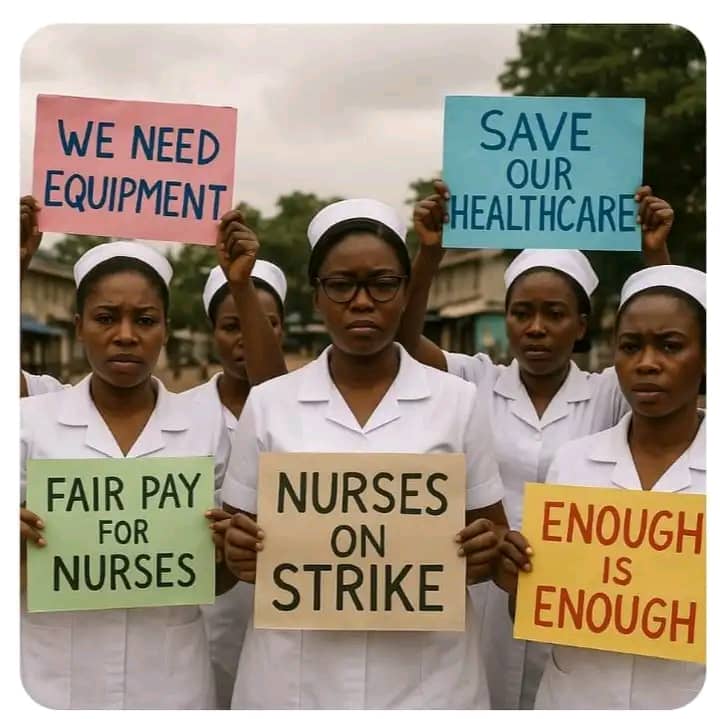
Beyond remuneration, NANNM’s demands cut deeper — they are calling for institutional reform and inclusion in policymaking. “We’ve been sidelined for too long,” Olufunmilola asserts. “Nurses are the backbone of hospital care. Yet, we are never involved when policies are being made.”
Their absence from key decision-making platforms means policies that affect frontline care are developed without insight from those who implement them. The nurses are not only calling for better working conditions but also for a system that sees and hears them.
Despite the significance of the strike, there has been no response from government authorities or hospital management, according to NANNM leaders.
“They’re acting like it doesn’t concern them,” Olufunmilola notes with frustration.
As the strike progresses, the uncertainty around its resolution grows. When asked what comes next after the warning strike, she responds: “When we get to the bridge, we’ll cross it.”
But for now, she has a message for the government: “If you want to stop this ‘Japa’ trend, equip our hospitals, provide infrastructure, and value your healthcare workers.”
To her colleagues, she offers rare words of care — a reminder to rest and recover. “Many are dying in silence. Use this time to take care of yourself and your family.”
In a country where the health system teeters on collapse, the voices of Nigeria’s nurses may be the only remaining lifeline. Whether or not the government listens — and acts — could determine the future of care for millions.
