
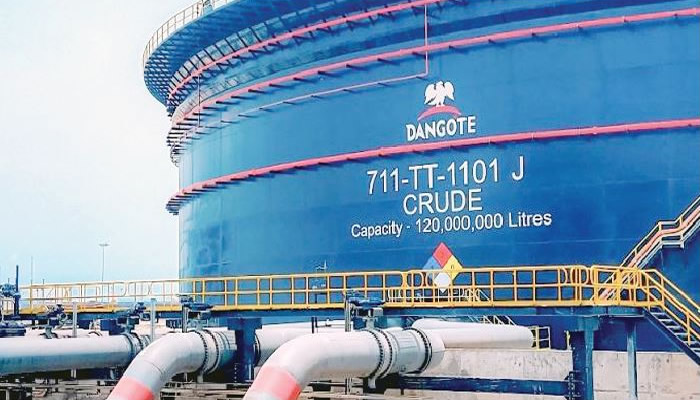
The Federal Government is set to deliver up to 400,000 barrels of Nigerian crude oil per day to the Dangote Refinery under a naira-for-crude agreement, according to a Bloomberg report released on Monday.
This development will see a total of 24 million barrels of Nigerian crude supplied between October and November 2024, significantly boosting the refinery’s processing capacity.
The move follows the recent commencement of the naira-for-crude deal, as announced by the Federal Government. Under the agreement, the Nigerian National Petroleum Company Limited (NNPC) will begin supplying crude oil to Dangote Petroleum Refinery this week, further consolidating efforts to streamline the country’s oil sector.
Industry analysts believe the increase in Dangote’s reliance on local feedstock will have a profound impact on the Atlantic oil market, as it is expected to reduce Nigeria’s crude exports significantly.
The 650,000-barrel-per-day refinery, which is the largest of its kind in Africa and Europe, will draw 13 to 14 shipments from Nigeria’s typical monthly output of around 50 cargoes.
Ronan Hodgson, an analyst at FGE in London, warned that the West African crude market is likely to become “substantially tighter” in the fourth quarter due to the new supply arrangement.
He predicted that Nigeria’s oil exports could fall below 1 million barrels per day as a result of the shift, stating that “some shipments over the next two months may not be delivered as planned.”
Bloomberg data also show that Dangote has already scaled up its processing capacity, taking in an average of 255,000 barrels per day over the first half of 2024.
Now operating at 60-70% capacity, the refinery is expected to reach full production in the coming months, according to Engineers India Ltd. Chairman, Vartika Shukla.
In addition to curbing exports, the ramp-up at Dangote Refinery is expected to decrease Nigeria’s reliance on imported fuel, helping the country achieve its goal of reducing costly oil product imports.
“If the refinery runs at higher rates, the West African market for gasoline and diesel imports will shrink extremely quickly,” Hodgson added.
This development also signals a shift in Dangote’s procurement strategy, as the refinery has reduced its purchases of US crude oil, opting instead for Nigerian supply.
Earlier this year, the refinery had imported millions of barrels of US West Texas Intermediate (WTI) crude, only to resell some of the stock and scrap plans for further imports.
The agreement between NNPC and Dangote gives the state-owned oil firm the exclusive right to distribute gasoline produced by the refinery, ensuring a steady supply to meet local demand.
