
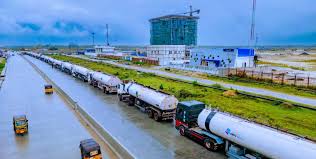
Nigeria’s major petroleum marketers have announced the suspension of petrol imports, citing increased local supply from the Dangote Refinery.
The refinery has ramped up its operations, delivering 148 million litres of petrol to marketers over the past 10 weeks, significantly reshaping the country’s fuel supply dynamics.
The Chief Executive Officer of the Major Energies Marketers Association of Nigeria (MEMAN), Clement Isong, disclosed this during a recent discourse on fuel pricing.
Represented by MEMAN’s Head of Economic Intelligence, Research, and Regulation, Ogechi Nkwoji, Isong revealed that marketers are now relying on the Dangote Refinery for supply, despite holding licenses to import petrol.
“Between September 16 and November 24, 2024, MEMAN members lifted a total of 148 million litres of petrol from the Dangote Refinery, averaging two million litres daily over 10 weeks,” Isong stated.
The volumes transported via trucks and vessels to marketers’ facilities in Lagos reflected an operational shift. Weekly breakdowns showed peak supplies of 29.4 million litres in Week 38, with subsequent fluctuations, reaching a low of 1.6 million litres in Week 46 before rebounding to 11.6 million litres in Week 47.
The suspension of petrol imports aligns with a federal government directive that ended the Nigerian National Petroleum Company Limited’s (NNPCL) intermediary role.
This policy change allows independent marketers to negotiate directly with local refineries, fostering competition and efficiency in the sector.
Isong explained that the pricing of petrol is influenced by several factors, including the Argus Gasoline Euro-Bob benchmark for West African deliveries, exchange rates derived from the Central Bank of Nigeria’s weighted average rate, and other cost components such as finance charges, freight costs, and regulatory levies.
“The spot price of petrol from October 10 to November 22, 2024, was N976.07 per litre, with an average price of N971.14 per litre during this period.
The cost per metric tonne stood at N708,390, calculated using a foreign exchange rate of N1,665.99 to the dollar,” Isong said.
He further highlighted operational costs tied to port charges, including towage, berthage, and contributions to regulatory bodies such as the Nigerian Ports Authority (NPA), the Nigerian Maritime Administration and Safety Agency (NIMASA), and the Nigerian Midstream and Downstream Petroleum Regulatory Authority (NMDPRA).
The Dangote Refinery, a $20 billion facility, now supplies a significant portion of Nigeria’s petroleum products, a development expected to enhance local supply security and reduce dependence on imports.
Major marketers like 11 Plc., Ardova Plc., Conoil, TotalEnergies, and others account for 40–50% of the nation’s petroleum market share.
Isong lauded the competitive market framework enabled by the refinery’s operations, emphasizing its role in stabilizing supply and prices within Nigeria’s petroleum sector.
